
With the rise of GLP-1s, labeling initiatives and health-conscious consumers, protein has become the most highly sought-after ingredient.1 But new research indicates that consumer perceptions about protein’s value extends well beyond nutrition.
Grande Custom Ingredients Group commissioned Hanover Research to explore consumer purchase intent and perception in its 2026 Protein Ingredients Value Study. The study surveyed 1,000 U.S. consumers who had purchased and consumed a high-protein or protein-enhanced product within the previous 30 days.
This article provides an overview of The 2026 Protein Ingredients Value Study findings, revealing new considerations for your R&D teams developing the next generation of protein-enhanced foods.
View the Complete Protein Ingredients Value Study
Consumers Look for Protein Outside the Sports Nutrition Aisle
Among surveyed participants, protein bars (74%) and beverages (66%) remain among the top food items purchased. That’s not surprising. However, items not often associated with the sports nutrition aisle make up a sizable portion of their protein eating habits.
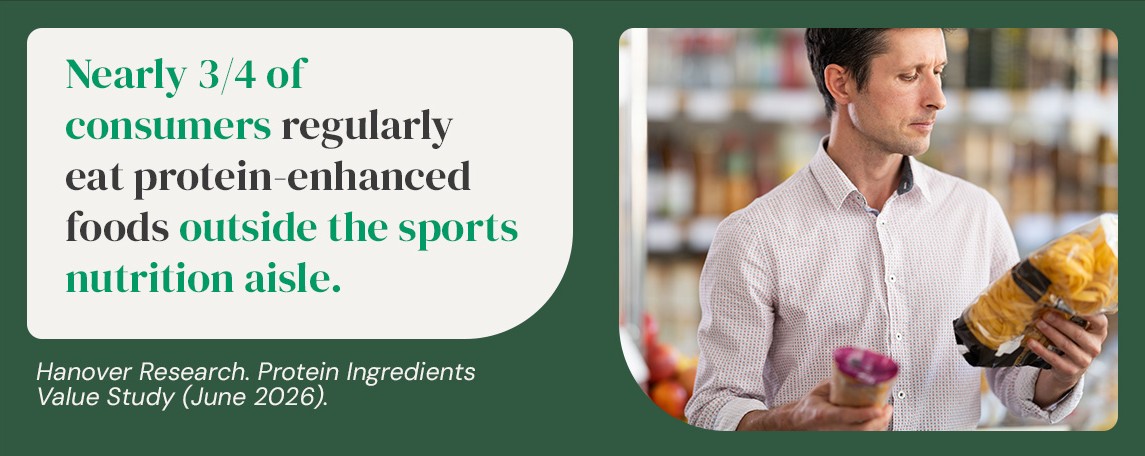
More than half of participants (52%) said they recently purchased a protein-enhanced food or entree, including frozen dinners, soup, pasta and other main-course meal items.
And these products aren’t occasional purchases. Among participants who purchased protein-enhanced foods or entrées, 71% consumed them at least weekly, including 24% who consumed them daily.
Demand for protein is extending into everyday meals—from entrees to desserts to snacks and more—creating opportunities for formulators to consider new food categories and protein delivery vehicles.
More Protein Increases Consumer Purchase Intent
There are numerous studies and market data telling us that consumers want protein. Similarly, the 2026 Protein Ingredients Value Study shows a strong consumer preference for higher protein content:
- 77% said higher protein content is very or extremely important when purchasing protein-enhanced products.
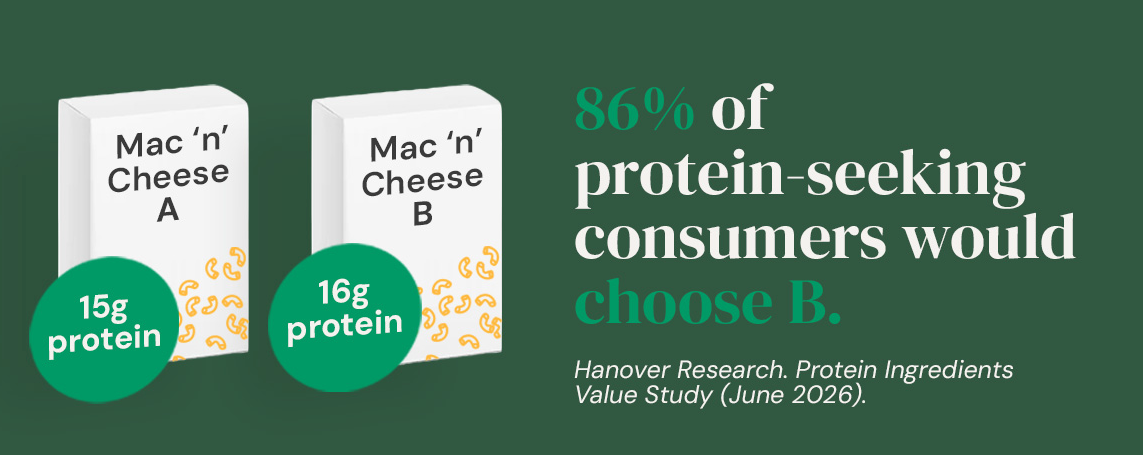
- 86% said they would probably or definitely purchase a protein-enhanced food or beverage with higher protein content than similar products.
Consider two comparable products on the shelf, one providing 15 grams of protein per serving and another providing 16 grams. The study suggests that 86% of consumers may favor the higher-protein product, making even incremental increases in protein worth considering during your formulation development.
Consumers Want to See Shorter, More Familiar Ingredient Lists
The number of protein grams isn’t the only information consumers look for on labels. Among consumers who look for protein on labels, 55% want it clearly listed in the ingredients.2 Consumers are also looking for simplicity. In the 2026 Hanover study:
- 67% said a simple ingredient list was very or extremely important when purchasing protein-enhanced products.
- More than half (56%) said the same about having fewer ingredients overall.
- 80% would purchase a product if protein enabled fewer ingredients.
The study also asked consumers what “clean label” means to them. Their responses centered on:
- Shorter, simpler ingredient lists
- Recognizable ingredients
- The absence of artificial additives, preservatives and chemicals
- Fewer fillers, including gums or starches
Consumers Read Ingredient Statements
Other research reinforces the attention consumers give food labels. A NSF survey found that 83% of Americans read ingredient labels before purchasing a food product.3 Nearly three in four reconsider a purchase after reviewing the ingredient list, according to Innova Market Insights.4
Ingredient familiarity can influence those perceptions, too. Research finds that unfamiliar ingredients may be perceived as chemicals or artificial ingredients by consumers.5
What if a protein ingredient could achieve the same results?
For your R&D teams, the latest research points to two strong consumer priorities that can coexist: higher protein content and a simpler ingredient statement. Formulation strategies that address both could help manufacturers capitalize on protein-driven purchase intent while creating the type of label consumers increasingly prefer.
Consumers Prefer Whey Protein Concentrate
Whey protein continues to be the consumer-preferred protein on labels.
The 2026 study found that 87% of consumers are familiar with whey protein concentrate (WPC). Among them, 69% reported a somewhat or very favorable impression of it.
The research also found that consumers associate WPC with the following benefits:
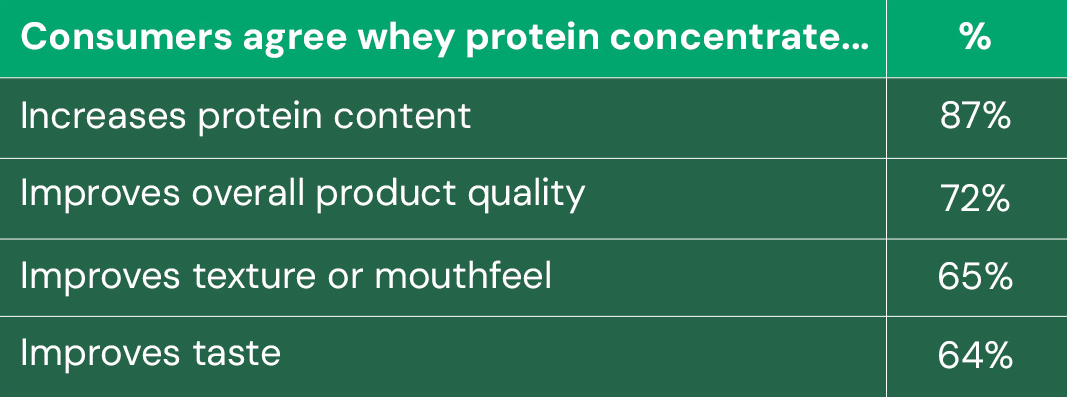
These findings suggest WPC carries a positive perception that extends beyond the nutrition facts panel. Consumers associate the ingredient itself with protein as well as quality, taste and texture. That combination creates an opportunity to evaluate WPC for both its consumer-facing value on the ingredient statement and its functional role within the formulation.
Whey Protein Concentrate Can Do More Than Add Protein
Consumers appear receptive to protein taking on a larger role in the formulation. In the Hanover Research study, 77% found the idea of using protein appealing when replacing ingredients typically used for taste or texture.
Functionality Depends on the Whey Protein Ingredient
Replacing a starch, gum or stabilizer requires an ingredient capable of performing a similar function in the food system. Depending on the ingredient, application and processing conditions, functional whey proteins can contribute to:
- Viscosity development
- Water holding capacity
- Emulsification and stabilization
- Texture and mouthfeel
- Syneresis reduction
- Fat mimetic properties
- Protein enrichment
It’s important to note that not all whey proteins perform the same in food systems. Processing differences can change protein structure and folding patterns and can lead to significant changes in functionality. A truly functional WPC needs to have the right performance throughout processing and application conditions. That’s why many commodity whey proteins fall short — they’re not optimized for functionality such as heat stability and water holding capacity.
How whey protein concentrates are made matters. And when comparing whey ingredients for use in food systems, it’s important to look at their functional properties as much if not more than their nutritional contribution.
Key Takeaways for Food R&D Teams
For your R&D teams, the 2026 consumer study on protein creates several formulation considerations:
- Look for opportunities to increase or maintain protein. With 86% indicating purchase intent for a higher-protein option compared with similar products, even incremental gains may provide meaningful differentiation.
- Evaluate the ingredient statement during reformulation. Consider whether functional whey protein ingredients can perform multiple roles and potentially reduce the total number of ingredients required.
- Consider protein functionality alongside protein content. Functional whey proteins can contribute properties such as viscosity, water holding, stabilization, texture and mouthfeel depending on the ingredient and application.
- Protect sensory performance. Ingredient simplification still has to deliver the eating experience consumers expect.
- Evaluate whey proteins for the specific food system. Protein concentration alone does not determine performance. Processing tolerance and the functionality required in the finished application should guide ingredient selection.
This expands the protein conversation from "How much protein can we add?" to "How much can our protein ingredient do?"
Download the 2026 Protein Ingredients Value Study for additional insights to help you evaluate protein through a wider formulation lens.
Grande Custom Ingredients Group is an innovator in the whey protein industry, developing functional ingredients specifically for food and beverage applications. By preserving and optimizing whey protein functionality, these ingredients can help R&D teams address formulation objectives ranging from protein enrichment to viscosity, texture, mouthfeel and moisture management.
Contact our team of food scientists and R&D specialists to explore which functional whey ingredient can deliver the nutrition and performance you’re trying to achieve in your formulation.
Get the latest research and formulation insights delivered to your inbox. Subscribe to Ingredient Insights by Grande today.
Sources:
Unless otherwise noted, data and statistics are compiled from the Hanover Research 2026 Protein Ingredients Value Study, commissioned by Grande Custom Ingredients Group.
- IFIC. Americans’ Perception of Protein (2025).
- IFIC. Americans’ Perceptions of Protein Quality & Labeling (April 2026).
- NSF. Research Shows Americans Demand Greater Clarity and Standardization in Food Labeling (2025).
- Innova Market Insights. Global Clean Label Trends (2025).
- Choi J, Chambers E 4th, Lee J. Consumer Sensory Perceptions of Natural Ingredients: A Multi-Country Comparison (2025).
- North Carolina State University. Sensory Analysis of Cheese Sauce (2021).
FAQ: 2026 Protein Ingredients Value Study
Does higher protein content increase purchase intent?
Yes. In Grande’s 2026 Protein Ingredients Value Study, 86% of surveyed consumers said they would probably or definitely purchase a protein-enhanced food or beverage with higher protein content than similar products. Additionally, 77% said higher protein content was very or extremely important when purchasing protein-enhanced products.
Can incremental increases in protein influence purchase intent?
Research suggests that higher protein content can differentiate comparable products. This makes incremental protein increases worth evaluating during formulation and reformulation.
How important are simple ingredient lists to consumers?
In the 2026 Hanover study, 67% of surveyed consumers said a simple ingredient list was very or extremely important when purchasing protein-enhanced products, while 56% placed the same importance on having fewer ingredients overall.
How do consumers perceive whey protein concentrate?
Among surveyed consumers familiar with whey protein concentrate (WPC), 69% had a somewhat or very favorable impression of it. Consumers also associated WPC with increasing protein content (87%), improving overall product quality (72%), improving texture or mouthfeel (65%) and improving taste (64%).
Do consumers prefer whey protein concentrate over gums or starches?
Yes. When asked which type of ingredient they preferred for specific product attributes, consumers favored WPC over standard ingredients such as gums or starches. 67% preferred WPC for improving overall product quality, 63% for improving taste and 60% for improving texture or mouthfeel.
Can whey protein replace gums, starches or stabilizers?
Yes. Certain functional whey protein ingredients can perform roles associated with viscosity, water holding, stabilization, texture and mouthfeel. Their ability to replace or reduce other functional ingredients depends greatly on the whey ingredient, food system, processing conditions and desired finished-product characteristics.
Why does whey protein functionality vary between ingredients?
Processing conditions can affect whey protein structure and functional performance. For R&D teams, selecting a whey protein therefore requires evaluating the functionality needed in the specific food system, including factors such as heat stability, water holding, viscosity and finished-product texture, rather than evaluating protein concentration alone.
Are consumers willing to pay more for products containing whey protein concentrate?
Among surveyed consumers familiar with WPC, 41% said they probably or definitely would pay a premium for a food or beverage product with whey protein listed as an ingredient compared with a standard version without it. The study also found that 76% agreed products using protein instead of other texture ingredients feel more premium.