

High-Protein, Low Trust? Rethinking Formulation in the Age of GLP-1s, Trend Fatigue & Protein Quality
By Antje Collman, Food Scientist
This article offers a formulation science perspective on protein quality, GLP-1 eating behaviors, and sensory performance, with implications for dairy and whey-based ingredient systems in CPG applications.
For most of the last decade, protein has been an easy answer.
- Need to refresh a product? Add protein.
- Need to justify a price increase? Add protein.
- Need to look relevant on store shelves? Put the number of grams of protein on the front of the package and make it bigger than last year.
And for a while, it worked.
Lately, it's been working less. Not because protein suddenly stopped mattering, but because consumers are getting better at separating nutrition math from their eating experience.
The rise of GLP-1 medications like Ozempic and Wegovy has accelerated that shift. When people eat less overall, every bite matters more. And as they lose weight, they need sufficient high-quality protein intake to mitigate muscle loss.
Products don’t get the benefit of the doubt anymore.
RELATED RESEARCH: Protein Preferences & Perception Study
The Protein Paradox
How do past nutrition trends foreshadow today’s perceptions on protein claims?
Protein used to be a differentiator. Now, it’s an expectation. Many consumers assume high protein levels, especially in products positioned as better-for-you. What they no longer assume is that the product will be satisfying, enjoyable or worth buying again.
This pattern is not new. Anyone who has been in the industry long enough has seen it repeat.
- The 1990s — Fat was the enemy. We removed it. Texture fell apart. Flavor flattened. Trust followed.
- The 2000s — High fiber became the mantra. It showed up on labels. Texture was inconsistent.
- The 2010s — Protein numbers hit their targets on paper, however... Bars were chalky. Drinks were gritty. Baked goods dried out by day two.
Each wave started with good intentions. Each wave pushed too far. Now, protein feels like it is brushing up against that same edge, and consumers are demanding more from their food products.
GLP-1s Change Eating Frequency
How do GLP-1 medications change portion size, snacking behavior and formulation priorities?
In a 2025 Kaiser Family Foundation poll, around 12% of U.S. adults reported current use of a GLP-1 medication, with nearly one in five saying they had taken one at some point.1 GLP-1 medications are often talked about in terms of weight loss or calorie reduction, but the more interesting change is behavioral. People eat less often. Portions shrink. Snacking becomes selective.
That changes the job of food.
When someone only eats a few bites, there is no room for filler. A thin sauce, a dry texture or an off note in flavor stands out immediately. Products that rely on nutrition claims rather than the eating experience fall apart faster in this environment.
Research on GLP-1 use suggests that appetite suppression leads to fewer eating occasions overall rather than dramatic shifts toward a single nutrient, which makes satisfaction and nutrient density within smaller portions more important than ever.2
This exposes something the industry has struggled with for years. We often optimize nutrition targets independently from the eating experience, even though consumers experience them at the same time.
Ultra-Processed Foods and the Trust Problem
What drives consumer distrust in ultra-processed foods — processing or a lack of marketing transparency?
Processing itself is not the issue. Anyone who works in food knows that fermentation, heating, drying and blending are fundamental tools.
What consumers are reacting to is the feeling that processing has replaced purpose.
Issues arise when ingredients exist primarily to support a claim rather than improve a product’s eating experience. The result?
- Skepticism creeps in
- Ingredient lists feel defensive
- Health positioning feels rehearsed
- Even well-designed formulations can lose credibility if they feel disconnected from real food
Consumer research shows that distrust around ultra-processed foods is driven less by processing itself and more by confusion and perceived opacity in how products are marketed.3
That shows up most clearly in products that talk loudly about protein but do very little to earn trust at the sensory level.
Protein Quantity Is Not the Same as Protein Quality
What is the difference between protein grams and biological protein quality?
This is where the conversation usually gets uncomfortable.
Not all protein behaves the same way in the body, even though it counts the same on a nutrition label. Collagen is the most obvious example. It contributes grams of protein, but it is incomplete and lacks key essential amino acids, including tryptophan. On its own, collagen does not support muscle protein synthesis in a meaningful way. Instead, it aids joints, skin and structure.
The problem comes when collagen is used primarily to inflate protein numbers in products positioned around satiety, strength or nutritional value. That gap between label and function is revealed with deeper nutritional comparisons, making consumers aware that labels don’t always live up to their claims.
How does whey protein behave differently than alternative proteins?
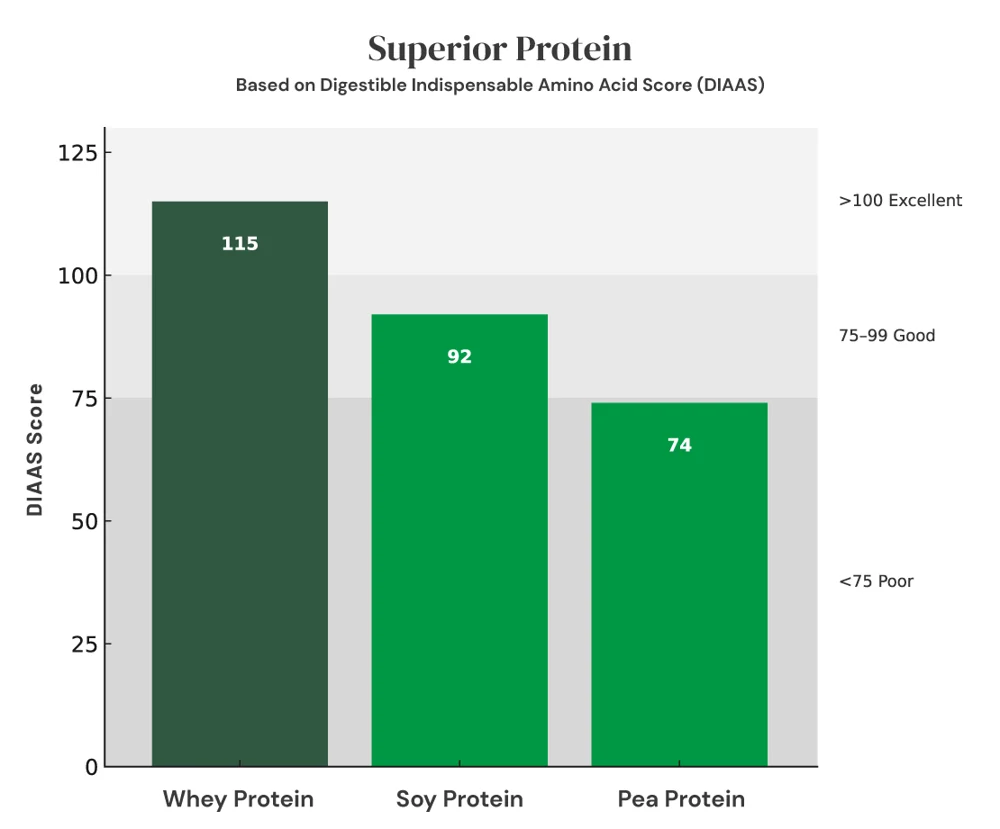
It is complete, highly digestible and rich in essential amino acids, including leucine, which plays a central role in muscle protein synthesis and metabolic signaling. From both a nutritional and functional standpoint, it delivers what many consumers expect when they see a protein claim, especially in a GLP-1-influenced eating pattern where fewer calories need to do more work.4
____________________________________________________
Formulation Science Reference Points
- PDCAAS / DIAAS: Protein Digestibility-Corrected Amino Acid Score and Digestible Indispensable Amino Acid Score measure protein digestibility and essential amino acid availability
- Leucine Threshold: ~2–3g per serving associated with triggering muscle protein synthesis
- Protein Completeness: Presence of all nine essential amino acids
- Functional Performance: Solubility, heat stability, water binding, and mouthfeel impact sensory outcomes
Whey protein achieves higher scores in the metrics that matter most.
RELATED ARTICLE: Protein Quality: Why All Proteins Are Not Created Equal
____________________________________________________
When Claims Run Ahead of Experience
Why do technically compliant products still fail in sensory performance?
Most formulators can name at least one product where the numbers were perfect and the product was not. Protein and sodium targets were achieved and the label was approved.
Then someone tasted it.
Consumers do not need to know what DIAAS or PDCAAS stand for to know when something feels thin, dry, gritty or unfinished. They do not need technical language to register disappointment.
Health claims used to build trust. Now they often raise suspicion. In a crowded category, the louder the claim, the more consumers seem to look for what it might be compensating for.
Some of the most technically impressive products I have worked around were also the least enjoyable.
Quiet Functionality Still Works
Quiet functionality is not a new idea. It is just easy to overlook when trends get loud.
It shows up in sauces that hold without explanation, in dairy systems that feel indulgent without advertising protein content, and in beverages where protein is present but never announces itself through chalkiness or astringency.
These products do not teach consumers why they are good. They let the experience do the work.
That approach feels more durable right now.
Rethinking What Better Actually Means
As GLP-1 use expands and consumers become more fluent in food marketing, the definition of better-for-you is shifting. Products are judged less on what they promise and more on how they perform in real eating moments.
For formulators, that means asking harder questions.
- Does this protein source actually support the benefit implied?
- Does the product still work when eaten in smaller portions?
- Does the texture reinforce satiety, or fight it?
- Are we solving a real problem, or just justifying a claim?
Those answers matter more than they used to.
Rebuilding Trust Through Formulation, Not Claims
The era of shouting about macros feels like it is winding down. Not because nutrition stopped mattering, but because consumers are tired of being sold numbers without substance.
Protein will remain a valuable tool. Protein quality, integration and sensory performance will decide whether it builds trust or erodes it.
In a post-GLP-1, trend-fatigued market, the products that last will not be the loudest. They will be the ones that quietly satisfy consumers during meal and snack times.
The food scientists at Grande Custom Ingredients Group understand the delicate balance between nutrition, flavor, texture and satiety. They’ve helped global brands achieve nutrition targets while delivering a quality eating experience using functional whey ingredients.
Contact our team to talk through your formulation challenge, and download our Protein Preferences & Perception Study to see what 1,000 consumers had to say about various protein types.
___________________________________________________
Formulator FAQ
Q: Does collagen count as a complete protein in finished products?
A: No. Collagen lacks tryptophan and does not meet essential amino acid requirements for muscle protein synthesis, making it unsuitable as a primary protein source for satiety or strength-based positioning.
Q: Why is whey protein better suited for GLP-1-influenced eating patterns?
A: Whey is a complete protein that delivers high leucine content, rapid digestibility, and strong sensory performance at moderate inclusion levels, making it effective in smaller, nutrient-dense portions.
Q: How much protein is too much for sensory performance?
A: This depends on the system type, but many beverage and bakery applications show texture and flavor degradation before meaningful satiety benefits scale proportionally.
Q: What matters more — PDCAAS or DIAAS?
A: DIAAS provides a more accurate reflection of amino acid bioavailability at the ileal level and is increasingly preferred in scientific evaluation of protein quality.
Sources
- Kaiser Family Foundation. Poll: 1 in 8 Adults Say They Are Currently Taking a GLP-1 Drug for Weight Loss, Diabetes or Another Condition, Even as Half Say the Drugs Are Difficult to Afford (2025)
- Choices Magazine. Food Demand in a Post-Ozempic World (2025).
- Attest. Ultra-Processed Foods: Tackling Consumer Confusion (2025).
- FAO. Dietary Protein Quality Evaluation in Human Nutrition; Wolfe, R.R. Branched-Chain Amino Acids and Muscle Protein Synthesis.