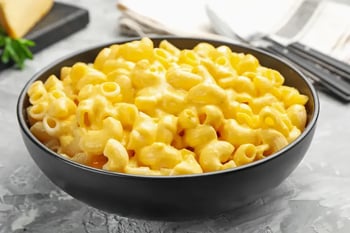
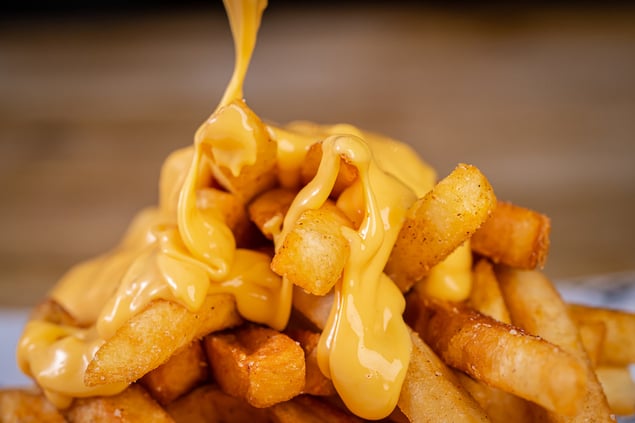
Textural properties strongly influence flavor perception in cheese sauces. A product may deliver excellent flavor yet still be rejected by consumers if the texture is perceived as gummy, grainy or unstable.
This sensory response to undesirable mouthfeel is studied through food rheology, the scientific discipline that examines the flow behavior and structural properties of food systems. If a food product doesn’t live up to its perceived consistency, it causes a psychological disconnect that is almost impossible to overcome no matter how good it tastes.
Shelf-stable cheese sauces are commonly used in applications such as:
- Canned or retort meals
- Jarred or bottled cheese sauces
- Shelf-stable meal kits
- Retort pouch cheese sauces
- Ready-to-eat cheese dips
- Frozen cheese sauces
In this article, we take a look at common formulation challenges associated with shelf-stable cheese sauces, and how food scientists can improve texture and performance using clean-label ingredients.
What is a shelf-stable cheese sauce?
A shelf-stable cheese sauce is a thermally processed cheese-based formulation designed to remain microbiologically safe and texturally stable at ambient storage conditions for extended periods.
What textural challenges are common in cheese sauces?
Common textural challenges with prepackaged cheese sauces result from a variety of production processes or improper ingredient selection, and might include:
- Syneresis — the separation or pooling of liquids
- A sticky or tacky mouthfeel
- Gummy or gelatinous consistency
- Viscosity breakdown
- Agglomeration — clumping or fish eyes
- Grittiness — a sand-like texture
Altering a cheese sauce formulation to improve texture and stability over its shelf life, reduce costs or improve nutrition poses many challenges for food formulators. It’s difficult to replicate the velvety smooth viscosity of a fresh, homemade cheese sauce in pre-made container products.
RELATED RESOURCE: Guide to Avoiding Common Food Formulation Fails
What causes poor texture and consistency in cheese sauces?
Processed cheese sauces are complex protein–fat emulsions. During thermal processing and storage, several factors can destabilize the casein network, fat emulsion or water-binding system, leading to texture defects.
The following factors most commonly lead to textural defects including syneresis, oil separation, viscosity loss and tacky mouthfeel:
- Insufficient protein functionality
- Excessive shear
- Improper heat treatment
- Incorrect emulsifying salt balance
- Imbalanced protein-to-moisture ratios
Lower fat formulations, in particular, have a higher probability of clumping and syneresis. In an attempt to restore a product’s integrity, food formulators may use alternative thickening or gelling agents. Unfortunately, some of these ingredients are not clean label and may simply replace one textural problem with another in addition to having off-flavors. Modifiers may be used to address some issues, but can be compromised by thermal treatments.
Additionally, the starch structure can break down under heat and shear, weakening the gel network and resulting in a stringy or unstable consistency.
If using powdered ingredients to improve viscosity in cheese sauces, properly hydrating them is a key step in producing creamy applications. However, many commodity thickening agents result in agglomerates when improperly heated or mixed into a formulation. Trying to break up the clumps may result in excessive shearing and further viscosity breakdown.
RELATED ARTICLE: Viscosity vs. Mouthfeel: The Difference & Why It Matters
Why are shelf-stable cheese sauces difficult to formulate?
Shelf-stable cheese sauces are challenging to formulate because the processing conditions and ingredient interactions required for long ambient shelf life can destabilize the delicate protein–fat emulsion that gives cheese sauces their smooth texture.
Common causes include:
- Retort or UHT heat stress
- Emulsion destabilization
- Fat separation
- Protein denaturation
- Hydrocolloid breakdown
Processed Cheese vs. Functional Whey Protein Concentrate: Food Lab Test Results
Grande Custom Ingredients Group conducted controlled lab testing to evaluate whether functional whey proteins could stabilize and improve texture in processed cheese sauces.
Two types of cheese sauces were tested, including a cheese sauce made with fresh cheese and a second made with cheese powder. In each formulation, the cheese ingredient was partially replaced with Grande Gusto® reduced-lactose whey at the following ratios:
- Fresh cheese replacement: 0.50 ratio
- Cheese powder replacement: 1:1 ratio
An independent sensory panel was assembled to rank the control using processed cheese versus the version using Grande Gusto. Grande Gusto scored significantly higher for viscosity while maintaining comparable scores for aroma, overall cheese flavor, milkfat perception and umami.
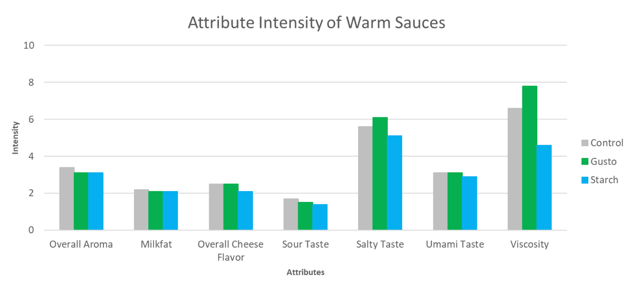
Source: Sensory Analysis of Cheese Sauce, North Carolina State University, April 2021
Additional Benefits Beyond Textural Improvements in Cheese Sauces
The controlled study also revealed significant nutritional benefits. Compared to the control cheese sauce using processed cheese, the formulation including Grande Gusto resulted in the following nutritional improvements.
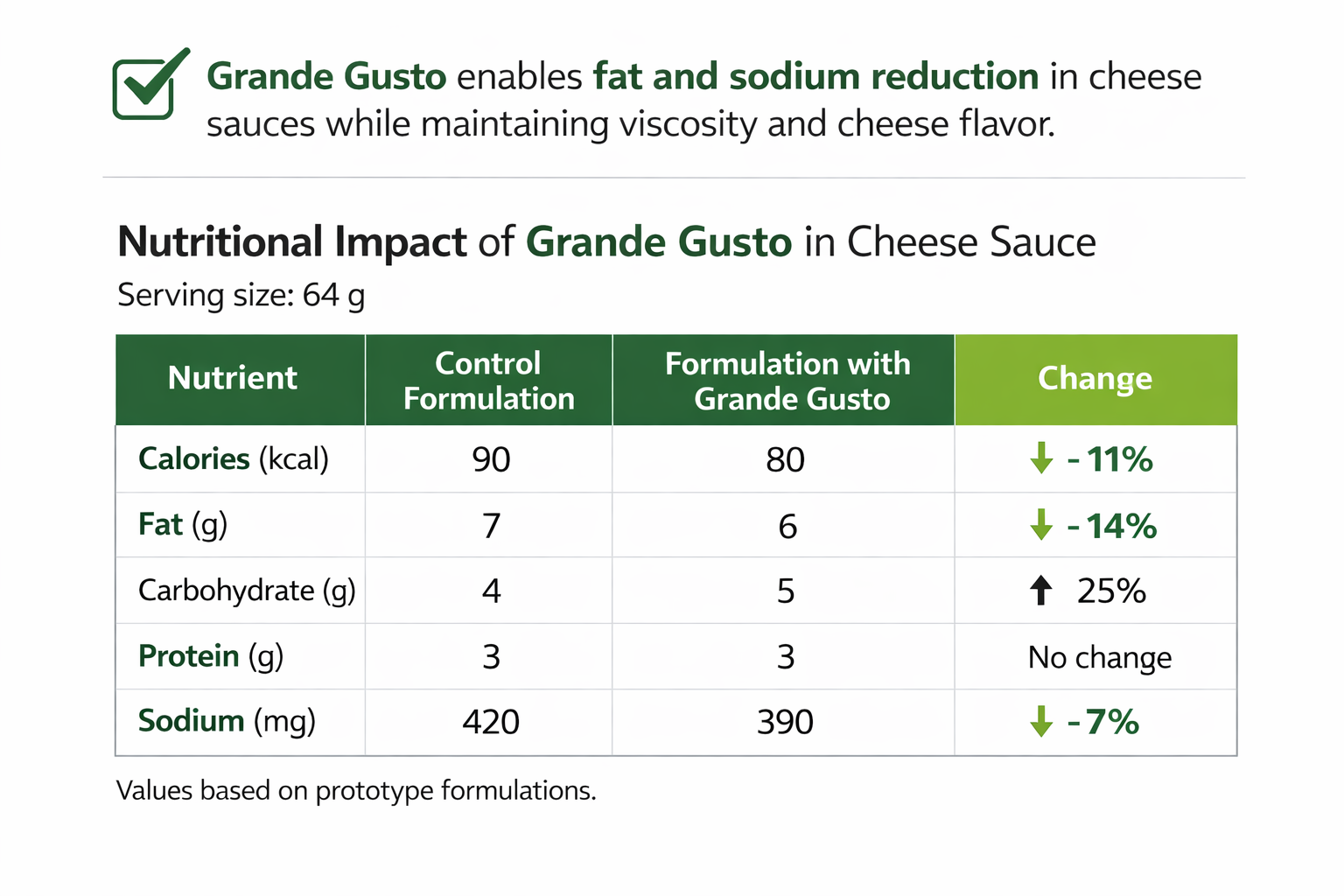
These nutritional improvements were achieved while also improving textural properties of the cheese sauce. When replacing fresh or processed cheese, cost savings are typically achieved as well.
Why does Grande Gusto perform differently in cheese sauces than commodity WPC?
Results using Grande Gusto are unique and could not be replicated when substituting commodity whey protein concentrate (WPC) in equal ratios in place of either fresh/processed cheese or cheese powder. The use of commodity WPC resulted in thin, watery consistencies, clumping, gumminess, agglomerates and other undesirable sensory attributes.
Commodity whey protein concentrates typically exhibit limited heat stability and lower water-holding capacity, making them less effective at stabilizing high-temperature cheese sauce systems.
Grande Gusto is made using a proprietary process that provides superior water-holding functionality and is heat and freeze/thaw stable, helping to create a lower rate of dissolve and eliminate common formulation challenges associated with other powdered dairies. It’s also derived from the highest quality milk, helping to eliminate extra processing and bleaching.
Grande Gusto is a real dairy ingredient that tastes like cheese and maintains the same creamy consistency because it’s naturally derived from the cheesemaking process. It is easily incorporated into existing food systems and formulations, maintaining its rich consistency throughout the product’s shelf life.
See for yourself why Grande Gusto appeals to food scientists seeking improved texture in shelf-stable cheeses, and why it won over the taste buds of an independent panel and convinced them that lower fat, fewer calories and reduced sodium formulations really can taste as good or better than the “real” thing.
Request a sample today, and reach out to our team of food scientists to explore using Grande Gusto in your cheese sauce formulations.
____________________________________________________
Formulator FAQ About Cheese Sauce Textural Challenges
Q: What makes shelf-stable cheese sauces difficult to formulate?
A: Shelf-stable cheese sauces are complex protein–fat emulsions that must remain stable during thermal processing and long ambient storage. High heat from retort or UHT processing can destabilize the casein network, leading to fat separation, protein aggregation, viscosity loss and syneresis.
Q: What ingredients stabilize retorted cheese sauces?
A: Retorted cheese sauces require ingredients that can withstand high heat while maintaining emulsion stability. Common stabilizing ingredients include functional whey proteins like Grande Gusto, emulsifying salts, starches and hydrocolloids that enhance water-holding capacity and viscosity. Heat-stable dairy proteins are particularly useful because they help maintain a smooth texture and prevent fat separation during retort processing.
Q: Can cheese sauces be reformulated to reduce fat or sodium without sacrificing texture?
A: Yes. Functional dairy ingredients can replace a portion of cheese or dairy fat while maintaining viscosity and flavor perception. This approach allows formulators to reduce fat, calories or sodium while preserving the creamy texture expected in cheese sauces.