
Executive Summary
Reducing fat and sodium in cheese sauces can help manufacturers achieve nutrition targets, but it also removes critical functionality that impacts flavor, texture, mouthfeel and sensory performance. Explore the food science behind why reduced-sodium and reduced-fat cheese sauces often fail sensory testing and the formulation strategies used to rebuild the attributes consumers expect.
In this article:
- What Sensory Attributes Are Lost When Fat and Sodium Are Reduced?
- Why Does Reduced-Sodium or Reduced-Fat Cheese Sauce Taste Bland?
- Why Can Cheese Sauces Have the Right Viscosity But a Poor Mouthfeel?
- Why Does Reduced-Fat Cheese Sauce Lose Viscosity?
- Is There a Single Clean-label Ingredient to Help Reduce Sodium and Fat in Cheese Sauces?
- How Can Grande Help?
Your prototype for a reduced sodium or reduced fat cheese sauce hit nutrition targets. Marketing is excited. Regulatory signs off. The nutrition panel looks great. But after sensory panel testing, you're sent back to the drawing board because the sauce tastes flat and simply isn't as satisfying as the original. Why?
It’s because sodium and fat do far more than contribute to nutrition panels on a label. When either is reduced, you remove crucial functionality and sensory attributes, too.
The challenge for teams like yours is understanding the functional roles of sodium and fat, not just their nutritional contribution.
In this article, we break down the most common reasons reduced-sodium and reduced-fat cheese sauces fail sensory testing, the food science behind why these issues occur and solutions to intentionally build those functional properties back into your formulation.
What Sensory Attributes Are Lost When Fat and Sodium Are Reduced?
Reduced-sodium and reduced-fat cheese sauce development often result in “build-back” exercises. In other words, once sodium or fat is removed, formulators must intentionally restore the functionalities of those components affected by these reductions.
The challenge is that improving one sensory attribute may unintentionally weaken another. A sauce may achieve target viscosity but still have a thin mouthfeel. Flavor intensity may improve, but richness or melt characteristics may fall short.
RELATED:
Sensory Panel Results: Shelf-Stable Cheese Sauce Formulation Improvement
The table below summarizes the key sensory and functional attributes most commonly affected when sodium and fat are reduced, followed by a deeper dive into why these issues occur.
The Functional Roles of Fat and Sodium Beyond Nutrition
| Attribute | Role of Fat | Role of Sodium | What Happens When Reduced |
|---|---|---|---|
| Flavor Intensity | Carries fat-soluble flavor compounds and adds richness | Amplifies cheese flavor and boosts flavor perception | Bland, muted or less complex flavor |
| Flavor Release | Extends lingering flavor perception | Supports flavor balance | Shorter, flatter eating experience |
| Viscosity | Contributes body and richness | Minimal direct impact | Sauce may feel thinner and require rebuilding |
| Mouthfeel | Creates creamy, tacky, lingering mouth coating | Supports smoothness via phosphate functionality | Thin, weak or fast-dissipating sensory experience |
| Texture Smoothness | Contributes creaminess | Supports emulsification and reduces graininess | Grainy, broken or less cohesive texture |
| Emulsion Stability | Helps maintain richness and consistency | Works with other minerals to create smooth consistencies | Separation or instability risk |
Why Does Reduced-Sodium or Reduced-Fat Cheese Sauce Taste Bland?
One of the first reasons reduced-sodium and reduced-fat cheese-based applications fail sensory testing is flavor. Even when a prototype hits nutritional targets, it often lacks the robust, complex flavor profile your consumers expect.
The issue goes beyond simply tasting “less salty” or “less rich.” Sodium and fat both play critical functional roles in flavor perception and delivery.
Sodium’s Impact Beyond “Salty” Flavors
Sodium does more than contribute a salty taste. It enhances and amplifies other flavor compounds as well, helping cheese flavors taste fuller, sharper and more complex.
Salt acts like a “cheerleader” for flavor, including umami. It boosts surrounding notes and helps them perform at their best. When sodium is reduced, formulators often find that the entire flavor profile becomes muted. Cheese flavors may suddenly taste dull, one-dimensional or imbalanced. So, you add Potassium Chloride (KCl) to bring back salty perceptions. That improves the saltiness, but now sensory panelists are picking up metallic or bitter notes.
Next comes another round of reformulation, additional flavor systems and another review meeting. Before you know it, you’ve spent months working on a formulation only to end up with a longer ingredient list and still can’t replicate the wonderful flavor of the original formula.
The Problem With Potassium Chloride
Challenge:
At higher levels, Potassium Chloride creates metallic, bitter or astringent off-notes, especially in dairy systems like cheese sauces.
Why formulators limit it:
Most systems can only tolerate partial replacement of sodium before sensory performance declines. That is why Potassium Chloride is often blended with other masking technologies, creating complex labeling while never quite achieving the original formula’s flavor or consistency.
Using a natural dairy ingredient like Grande Gusto® functional whey protein can help increase salty notes in formulations while reducing sodium and fat.
Fat’s Impact on Flavor Release
Just like sodium, fat serves an equally important function in flavor perception. Cheese contains fat-soluble flavor compounds that contribute to richness and complexity. Fat helps carry these compounds, suspend them within the system and control flavor release during eating.
When fat is removed or reduced, the cheese sauce loses richness and depth. Flavor becomes flatter and dissipates more quickly rather than building and lasting through consumption.
While sodium reduction tends to have the larger overall impact on flavor intensity, fat reduction significantly influences richness and flavor release—two qualities that consumers strongly associate with indulgent cheese sauces.
Why Can Cheese Sauces Have the Right Viscosity But a Poor Mouthfeel?
A sauce can look perfect on a spoon and still have a disappointing mouthfeel. Unfortunately, hitting your viscosity target on paper doesn't guarantee a satisfying eating experience.
That’s because viscosity and mouthfeel are not the same thing.
How Fat Drives Mouthfeel
Fat contributes to the heavier, tackier mouthfeel consumers associate with prepared cheese sauces. It creates a lingering mouth coating that helps flavors remain present and creates a more indulgent eating experience.
When fat is reduced or removed, formulators often lose this lingering sensation. The result is a thinner, more watery mouthfeel that dissipates quickly in the mouth.
This disconnect is one reason reduced-fat cheese sauces may perform well with rheometer testing yet still fail sensory panels.
Starches Alone May Not Solve Mouthfeel Problems
Many formulators attempt to rebuild texture lost through fat reduction by adding starches, but starch-based systems may not fully restore that desired cheese-like mouthfeel.
While starch can increase viscosity, starch-thickened systems may lose body quickly during consumption because salivary α-amylase (a digestive enzyme) immediately begins breaking down starch molecules in the mouth and accelerates the rate of dissolve.3
This explains why some reduced-fat cheese sauces appear thick during bench-top testing but still feel weak or watery during sensory evaluation.
How Sodium Reduction Impacts Emulsification
Sodium also contributes indirectly to mouthfeel mainly by how it interacts with other minerals in the sauce. Calcium, sodium and phosphates have a symbiotic relationship, and reducing sodium can alter protein charge behavior, hydration and binding interactions.
In processed cheese systems, phosphates help smooth and emulsify the sauce by disrupting calcium interactions that would otherwise create graininess. Without proper phosphate functionality, melted cheese systems can separate rather than stay cohesive.
When you reduce sodium, you may see unintended changes in melt behavior and overall sensory quality. Instead of a smooth, creamy sauce, the result may be grainy or less stable.
RELATED:
How to Improve Cheese Sauce Texture at Production Scale
Why Does Reduced-Fat Cheese Sauce Lose Viscosity?
In a full-fat cheese sauce system, the fat contributes to the body and thick texture consumers expect. When fat is reduced, formulators don’t just remove calories, they remove part of the physical structure. That’s why they often turn to starches, gums or hydrocolloids to rebuild viscosity.
But developers often face multiple rounds of reformulation to find the right stabilizer combination, which can increase both ingredient complexity and R&D timelines. Every new gum, starch or hydrocolloid may improve one attribute but also create new challenges.
In the end, the results still fail to fully replicate the eating quality of the original full-fat cheese sauce.
Sodium’s impact on viscosity is more indirect. In cheese sauce systems, sodium-containing emulsifying salts help chelate calcium bonds to give a smoother final product without a grainy appearance.
When sodium is reduced, changes in phosphate functionality may subtly affect viscosity and texture, though these effects are typically less pronounced than those caused by fat reduction. The greater the sodium reduction, the lesser the viscosity.2
Is There a Single Clean-label Ingredient to Help Reduce Sodium and Fat in Cheese Sauces?
Yes there is. Many traditional formulation solutions try to solve one problem at a time. For example:
- Potassium Chloride may help reduce sodium and restore salty flavors but can introduce metallic or bitter off-notes.
- Starches and gums may help rebuild viscosity loss from reducing fat, but often fail to recreate the lingering mouthfeel consumers expect from cheese sauces.
These solutions may hit nutritional targets but at the expense of a longer ingredient statement, less desirable flavor or suboptimal texture compared to the original formulation.
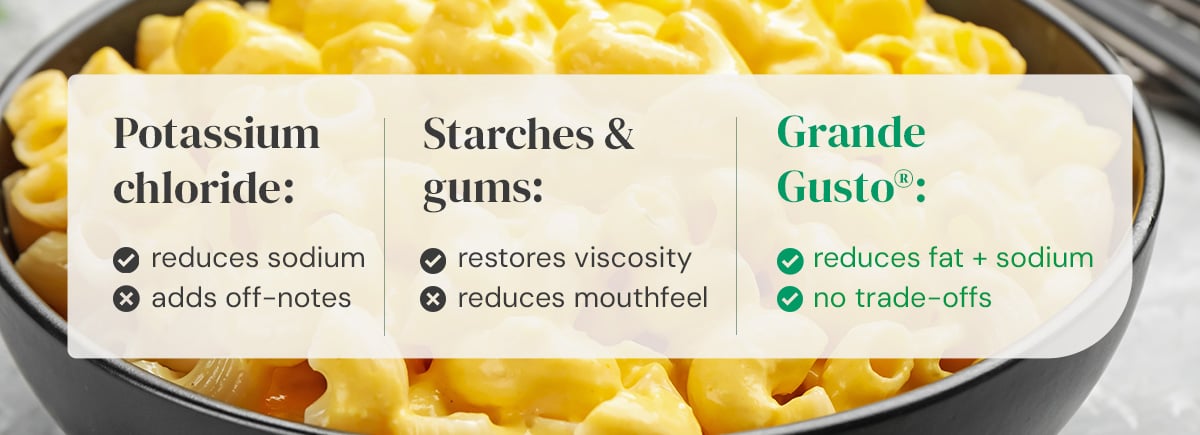
But Grande Custom Ingredients Group developed a solution. Grande Gusto is a functional whey ingredient made from all-natural, clean-label dairy that achieves both goals in a single ingredient. It is derived from the cheese-making process and maintains many of the attributes of cheese while improving nutrition.
When replacing a portion of cheese or cheese powders in formulations, it can:
- Reduce sodium up to 10%
- Reduce fat and calories up to 25%
Grande Gusto performs differently than alternative commodity ingredients because it helps rebuild both flavor and texture functionality simultaneously through a proprietary process.
VIEW GRANDE GUSTO PRODUCT INFORMATION
How Grande Gusto Helps Restore Functionality in Reduced-Sodium and Reduced-Fat Cheese Sauces
| Challenge | Traditional Approach | How Grande Gusto Helps |
|---|---|---|
| Flavor Loss from Sodium Reduction | Potassium chloride restores salty perception but introduces metallic, bitter or astringent off-notes at higher levels. | Proprietary mineral blend contributes salty and umami perception and supports a fuller cheese flavor profile. No off-notes. |
| Loss of Richness and Flavor Complexity | Additional flavor systems can compensate for muted cheese flavors but lengthen the ingredient statement. | Supports a more robust cheese flavor profile and contributes savory and salty notes, all in a single clean-label ingredient. |
| Reduced Viscosity | Starches and hydrocolloids rebuild body and thickness, but at the expense of mouthfeel. | Functions as a fat mimetic that helps rebuild viscosity in reduced-fat systems without the mouthfeel trade-off. |
| Poor Mouthfeel | Gums may help achieve target mouthfeel, but too much leads to gelatinous textures. | Helps create a heavier, tackier and more lingering mouthfeel that more closely resembles a full-fat cheese sauce. |
| Texture Challenges | Multiple ingredients are required to balance texture, stability and sensory performance, adding complexity and cost. | Water-holding capacity and proprietary processing help create a more cohesive texture and particle suspension in one ingredient. |
THE WHEY FORWARD (KEY TAKEAWAYS)
- Reducing fat or sodium in cheese sauces removes more than calories. It removes the functionality that drives flavor intensity, viscosity and mouthfeel.
- Viscosity and mouthfeel are not the same thing. A sauce can pass a bench test and still fail a sensory panel.
- Traditional solutions like potassium chloride and starches fix one problem and often create another: off-notes, a longer ingredient statement or a thinner eating experience.
- Grande Gusto addresses flavor, viscosity and mouthfeel in a single clean-label ingredient, reducing sodium up to 10% and fat and calories up to 25% without compromising the sensory profile your panel expects.
Let Us Help You Reduce Fat and Sodium Without Sacrificing Sensory Quality
If you’re frustrated with formulating healthier cheese sauces that taste great and have a satisfying texture, give Grande Gusto a try. You can address several sensory issues simultaneously while also improving nutrition.
Our team of food scientists is here to help you achieve those goals, naturally. Bring us your toughest reduced-fat or reduced-sodium challenge. Our food scientists are ready to work through it with you. Contact a Grande Custom Ingredients formulation specialist today.
Want more ingredient insights like this delivered to your inbox? Subscribe to the Grande CIG blog today.
Sources:
1 National Library of Medicine, Front-of-Package Nutrition Rating Systems and Symbols: Phase I Report. (2010)
2 Science Direct: Mozuraityte, R., et al., Sodium Reduction in Processed Cheese Spreads and the Effect on Physicochemical Properties. (2019)
3 Laguna, L., Farrell, G., Bryant, M., Morina, A., Sarkar, A., Relating Rheology and Tribology of Commercial Dairy Colloids to Sensory Perception. (2017)
FAQ: Reduced-Sodium and Reduced-Fat Cheese Sauce Formulations
Why do reduced-sodium cheese sauces taste bland?
Reduced-sodium cheese sauces often taste bland because sodium does more than contribute a salty taste. Salt enhances cheese flavor, boosts umami and amplifies surrounding flavor compounds. When sodium is reduced, cheese sauces may taste flatter, less complex or less balanced unless flavor functionality is intentionally rebuilt.
Why does reduced-fat cheese sauce feel thin even when viscosity looks correct?
Viscosity and mouthfeel are not the same thing. While starches and gums can rebuild thickness, fat contributes a heavier, tackier mouthfeel and lingering creaminess. A cheese sauce may appear thick during benchtop testing but still feel thin during eating if the mouthfeel is not properly restored.
Why is potassium chloride not always enough for sodium reduction?
Potassium chloride (KCl) can help restore salty perception, but at higher levels it may introduce metallic, bitter or astringent off-notes, especially in dairy systems. Because of this, many reduced-sodium cheese sauces require additional flavor modulators or functional ingredients to maintain sensory quality.
How does sodium reduction affect cheese sauce texture?
Sodium affects more than just the flavor of your sauce. In cheese sauce systems, sodium-containing emulsifying salts help cheese sauces’ proteins stay hydrated and texture stay smooth. When sodium is reduced, changes in phosphate functionality may affect emulsification, resulting in grainier textures, reduced smoothness or less stable sauce systems.
What ingredients help improve mouthfeel in reduced-fat cheese sauces?
Reduced-fat cheese sauces often require ingredients that rebuild both viscosity and mouthfeel. While starches and gums may improve thickness, they do not always recreate the rich, lingering eating experience consumers expect. Functional dairy ingredients that act as fat mimetics (like Grande Gusto) help restore creaminess, texture and sensory performance more effectively.
What are FDA definitions of low or reduced sodium?
The FDA strictly regulates reduced or low-fat and sodium claims per serving size (RACC) on packaging.1
| Claim | FDA Definition |
|---|---|
| Low Fat | 3 g or less per RACC (and per 50 g if RACC is small) Meals and main dishes: 3 g or less per 100 g and not more than 30% of calories from fat |
| Reduced Fat | At least 25% less fat per RACC than an appropriate reference food (or, for meals and main dishes, at least 25% less fat per 100 g) |
| Low Sodium | 140 mg or less per RACC (and per 50 g if RACC is small) Meals and main dishes: 140 mg or less per 100 g |
| Reduced Sodium | At least 25% less sodium per RACC than an appropriate reference food (or, for meals and main dishes, at least 25% less sodium per 100 g) |